Introduction to Linked List
Linked List is basically chains of nodes where each node contains information such as data and a pointer to the next node in the chain. It is a popular data structure with a wide range of real-world applications. Unlike Arrays, Linked List elements are not stored at a contiguous location. In the linked list there is a head pointer, which points to the first element of the linked list, and if the list is empty then it simply points to null or nothing.
Basic Terminologies of Linked List
- Head: The Head of a linked list is a pointer to the first node or reference of the first node of linked list. This pointer marks the beginning of the linked list.
- Node: Linked List consists of a series of nodes where each node has two parts: data and next pointer.
- Data: Data is the part of node which stores the information in the linked list.
- Next pointer: Next pointer is the part of the node which points to the next node of the linked list.
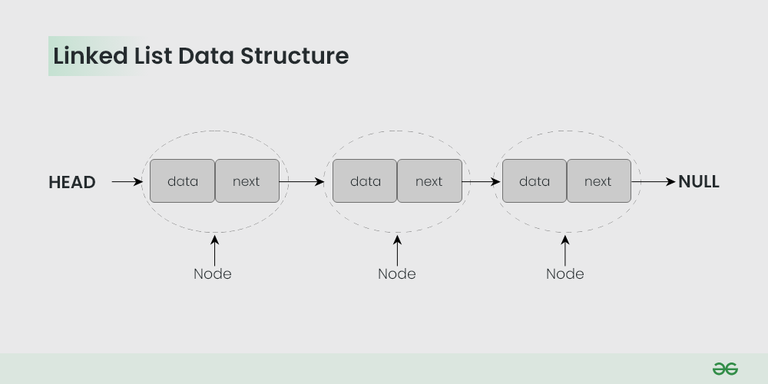
Importance of Linked List
- Dynamic Data structure: The size of memory can be allocated or de-allocated at run time based on the operation insertion or deletion.
- Ease of Insertion/Deletion: The insertion and deletion of elements are simpler than arrays since no elements need to be shifted after insertion and deletion, Just the address needed to be updated.
- Efficient Memory Utilization: As we know Linked List is a dynamic data structure the size increases or decreases as per the requirement so this avoids the wastage of memory.
- Implementation: Various advanced data structures can be implemented using a linked list like a stack, queue, graph, hash maps, etc.
Creating a Linked List
linkedList.cpp
class Node{
    Public: // access modifier
    int data; // the data value
    Node* next; // the pointer to the next value
    Public:
    // constructor
    Node (int data1, Node* next1){
        data=data1;  // Initialize data with the provided value
        next=next1;  // Initialize next with the provided
    }
    Node (int data1){
        data=data1;  // Initialize data with the provided value
        next=nullptr;  // Initialize next as null since it's the end of the list

    }
};
int main(){
    vector<int> arr={2,5,8,7};
    Node* y= new Node(arr[0]);
    cout<<y<<'\n'; // returns the memory value
    cout<<y->data<<'\n'; // returns the data stored at that memory point
}
output
0x11b7f90  // refering to address
2   // value at particular address